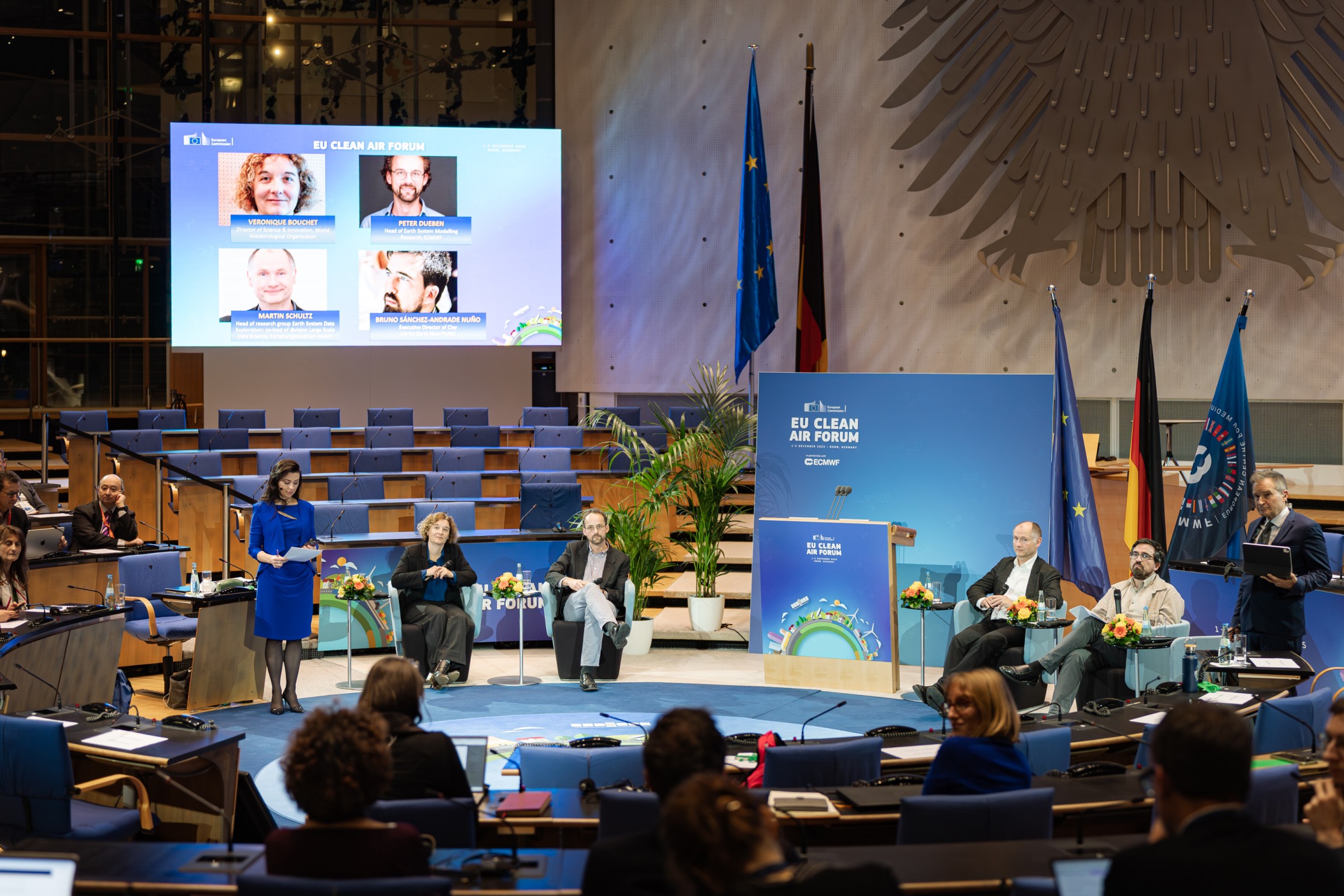
I was recently invited to come to the European Commission conference on Clean Air, about the role of AI. Most people would expect the usual story: AI will make things faster , models better , and cheaper. All of that is true, but that’s not the point.
The most important aspect of AI here, and in many other domains, is to make stuff invisible. Stuff that just works, reliably, so we can build on it, depend on it, and focus on outcomes, not tools. To reduce the cognitive load, not increase it.
Make Clean Air Invisible
The best clean-air system isn’t the one with the smartest dashboard. It’s the one you barely notice — because it quietly works, every day, like drinking water or electricity. And once you look at the problem through that lens, Europe’s situation becomes strangely simple:
Regulation: We arguably have the best clean air law on paper.
Data: We arguably have the best clean air Data from satellite and sensors.
Tools: We arguably have the best clean air models.
But we keep adding successful dashboards and pilots that don’t become standard services. All while air pollution remains Europe’s largest environmental health risk, and the burden is still huge: the EEA estimates 182,000 premature deaths in the EU-27 in 2023 attributable to PM₂.₅ exposure , plus substantial burdens from NO₂ and ozone. European Environment Agency+1
Regulation: Europe leads (and raises the bar)
The revised Ambient Air Quality Directive entered into force on 10 December 2024, aligning 2030 standards more closely with WHO recommendations and strengthening monitoring/modelling, air-quality planning, public information, access to justice, and even rights to compensation when EU air-quality rules are violated. European Environment Agency It also tightens core targets by 2030 — for example reducing the annual NO₂ limit from 40 → 20 μg/m³ and PM₂.₅ from 25 → 10 μg/m³ (still above WHO guideline levels, but a major step). Umweltbundesamt.
Now, AI should be a force multiplier for these laws — but the needed trust/governance layer of AI so we can apply the force of law is weakening. The EU AI Act to build trust is being carved through a Digital Omnibus on AI simplifying implementation — including pushing parts of the high-risk timeline out (up to ~16 months), framed as aligning obligations with the availability of standards and support tools. PS. Alemanno
Whether you see that as pragmatic sequencing or quiet weakening, the practical effect is the same for: stronger clean-air outcome obligations + less clarity (and more politics) around AI compliance timing.
Data & tools: from scarcity to world leaders
On the technical side, Europe has built an extraordinary stack.
Sentinel-4 provides hourly atmospheric composition observations over Europe (geostationary), at about 8 km resolution. European Space Agency
Sentinel-5 supports daily global coverage for air pollution and related atmospheric variables. European Space Agency
CAMS (Copernicus Atmosphere Monitoring Service) provides daily European air-quality analyses and forecasts at ~10 km (0.1°) , built from an ensemble of 11 forecasting systems , with hourly timesteps. ads.atmosphere.copernicus.eu
AI models like MSFT+Oxford Aurora and ECMWF IFS, with orders of magnitude faster and cheaper, and more accurate predictions.
So the bottleneck is no longer “do we have data?” or “can AI model this?”
It’s orchestration.
Where We’re Failing: Dashboards, Pilots, and Cognitive Overload
The pieces above should spell progress. Instead, we built:
a museum of complex dashboards , and
a graveyard of stories of successful pilots that die when the grant ends.
What stakeholders of clean air, like cities, actually need aren’t more layers of complexity. They need simplicity, they need answers: Is today safe for children to play outside? Which street to close traffic to, for how long, with what effect? Which boilers / emitters do we phase out first to cut exposure fastest?
And here’s the uncomfortable truth: this is not an air-quality-specific pathology. It’s a public-sector pattern. The OECD notes (using EU public-sector inventories) that a majority of public-sector AI use cases remain planned/pilot/in development, and that skills gaps and overreliance on procurement commonly block the move from pilots to sustained operations. OECD
This is why I don’t think the “AI for clean air” story is primarily about faster/better/cheaper. It’s about cognitive relief.
AI should reduce the load on mayors, transport officials, school principals, and citizens — not turn cities into mini data-science labs just to evaluate tenders and interpret uncertainty.
Making Clean-Air AI Invisible: From Pilots to Services with SLAs
The missing piece, in my opinion, is as boring as it is effective: procuring services.
Not more advanced pilots — but procure reliable services with service-level agreements that cities can buy and trust, like water or electricity.
A pilot that succeeds technically but never becomes a service is not a success. It’s the most expensive kind of failure — because we didn’t learn from the failure, nor did we learn anything we can turn to operational value.
A focus on answers, and services, puts responsibility in the right place: Citizens should not need to understand ppms, chemistry, ensembles or neural nets to demand clean air. They need to trust that independent experts have procured and audited the services — and that decisions are evidence-based and accountable. Just like we trust GPS services but most people don’t even know it. It just works when you need directions.
Yes, public in-house AI capacity must grow. But we also can’t wait for every city to become an AI shop before delivering cleaner air. We need a credible service layer that covers the gap while capacity builds.
The Problem Isn’t Innovation. It’s Orchestration.
I believe we are not blocked by lack of good laws. Or good data. Or good AI. Our problem is also not a lack of innovation. It’s a lack of service focus and orchestration.
So my key remark was simple: Less dashboards. More procurement. Help cities procure answers with accountability — not just better models, pilots, and skills. Those will align with the service demand.