I finished my second IRONMAN at 45 years of age in 14 h 44 min 56 s—43 minutes and 34 seconds faster than when I did it at 35. I was also 157th of 167 men in the M45–49 division.
It was hard—really hard—but I honestly enjoyed it. To be precise, I enjoyed discovering that I still had the physical endurance and mental will to complete such a challenge. The human body and mind are amazing. It is also true that I may be the slowest IRONMAN finisher you will ever meet: of 2,501 ranked finishers, only 75 finished behind me. This race had a particularly fast cohort, and I was near the back of it. That is totally fine with me. It is a rare cohort to belong to, below I calculate exactly how rare.
I did IRONMAN Chattanooga ten years ago. One of the main reasons I challenged myself to race again was to return after a decade and see how my body, mind and life had changed. At 35 I noticed that older athletes seemed slower but often more consistent and composed. At 45 I wanted to know whether I still had it in me to finish an IRONMAN, and whether experience, parenthood and knowing my body better would compensate for age and a very different life. The answer: I was faster than my 35-year-old self, but farther back among the men in my age division who finished.
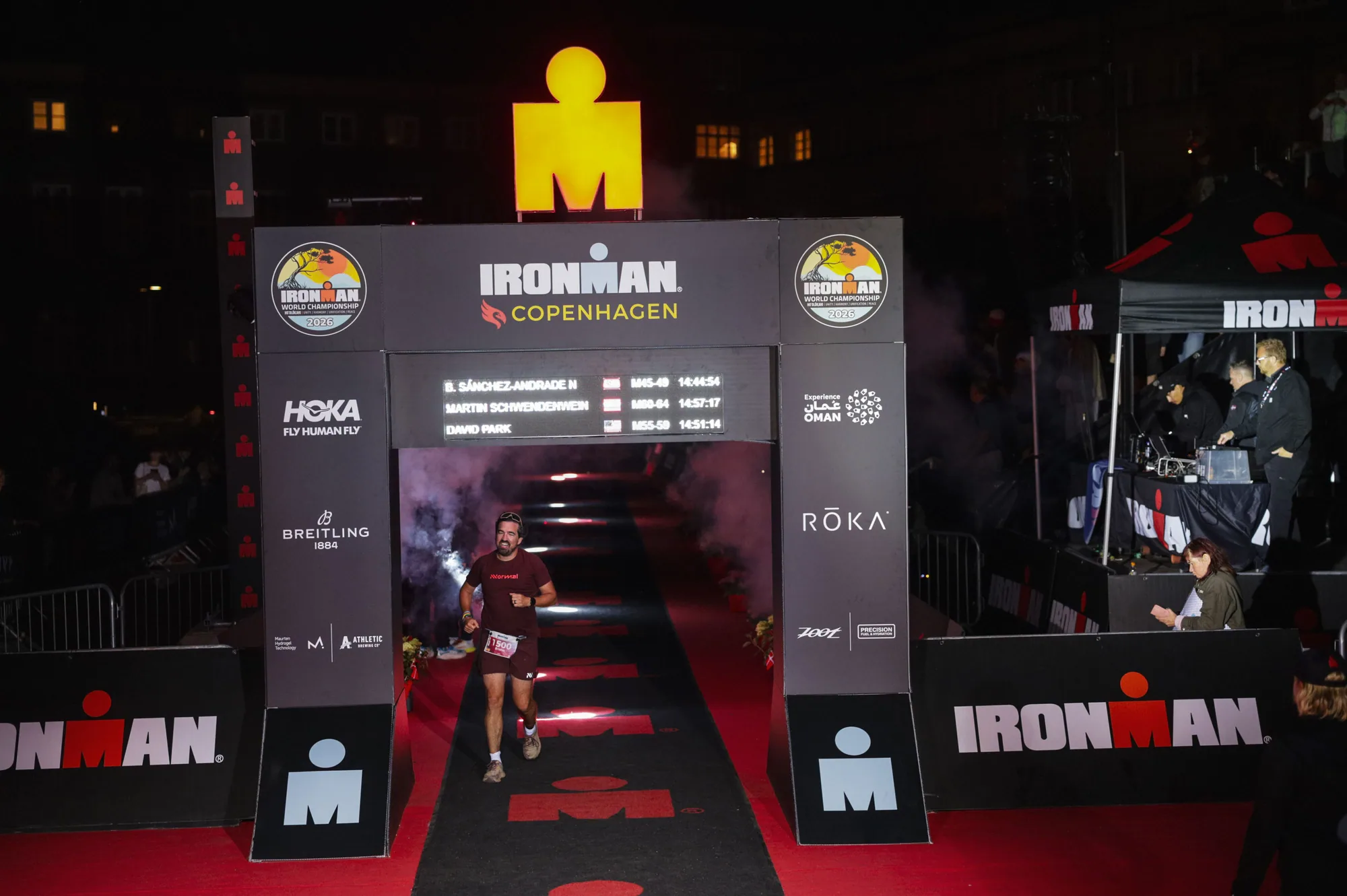
I did it.
The decade between the two start lines
At 35 I was mostly a fit workaholic with a lot of time. Training was, half-jokingly, my relationship status. At 45 I have a wonderful wife supporting me and two small children. Parenthood may have made me more used to functioning while tired, carrying weights and eating imperfectly, but it did not create extra hours. I had to take time from everywhere, including family time. In fact, every long training session was one that Emma had to cover,so achieving this finish also belongs to her.
Because of the tighter bandwidth, I thought I had trained much less. In the final 180 days, however, I recorded almost the same number of sessions: 138 before Chattanooga and 136 before Copenhagen. The difference was their duration. Strava moving time fell from 187 to 141 hours, a reduction of 46 hours, or 24%. In the final 90 days it fell from 94 to 74 hours (20%); in the final 42 days, from 39 to 21 h (45%). So I did train fewer hours, especially during the peak. Ironman endurance depends on sustained, specific work and the ability to hold a conservative effort for a long time. Ten years ago I paid a group coach and used the TrainingPeaks app. This time I still used the same app, but I also relied heavily on a ChatGPT coach persona to adjust the plan around travel, work, family and recovery. I reached the start without an injury, and I finished without one. That was a real success. The build, however, proved weakest where I had always thought I was strongest: the run.
Race day
Before sunrise
The alarm goes at 3 a.m. I skip the full breakfast I had planned because my stomach had been very unsettled the previous day. That is a gamble, but I trust the extra time and the chance to take in some carbohydrate before the swim. I put on tri shorts, pull the wetsuit to my waist and pack my cap and goggles. Emma and the kids are asleep in another hotel room.
I walk out and take the public bus—the same one people use for the airport. I smile at how strange it is to be surrounded by a few travellers with suitcases while I am the only person wearing a wetsuit. Then I look at the route map beside the driver and realise why: I am on the wrong bus. Thousands of athletes are trying to reach the same start, and somehow I have selected the one that is not taking any of them there. There is always a glitch on executing any plan; let this be the one. It is also a great opportunity to practise adjusting the plan to reality. We have time. The nearest workable stop leaves me an extra 20-minute walk in the dark. This is why I woke up absurdly early. I put techno music on my headphones and walk. Nothing is open for coffee. As I approach the venue, one fellow athlete becomes ten, then hundreds.
There is a point near the start line where we cross a bridge. The swim itself goes under that bridge. The sun has not risen and there is no wind, so the lagoon is a mirror reflecting the bridge and the stream of people heading towards the start line. My start line. This is it. This is the day.
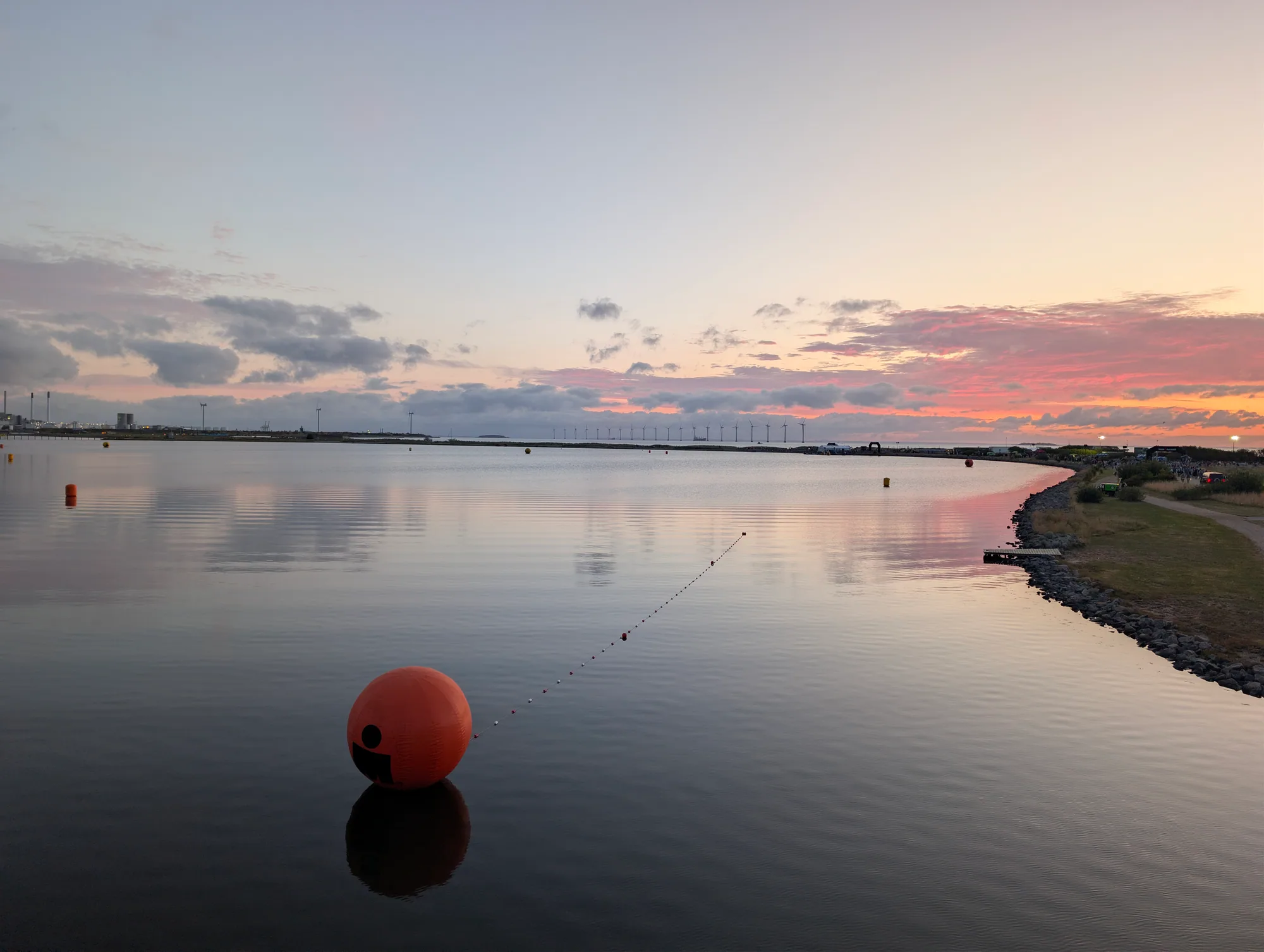
Before sunrise, the lagoon was a mirror.
At this point I’m surrounded by other participants and their families. I remember that I do not race other people. My IRONMAN is entirely about my body, my mind, how I feel, how I talk to myself and where I am in life. It is a chance to feel intensely alive for an entire day. And that day is today. In a couple of hours. I am ready. Goosebumps. I check the bike, find coffee and an apple, and hand over the bag with my phone and flip-flops. The sun rises. I think: I will see it set and I will still be racing.
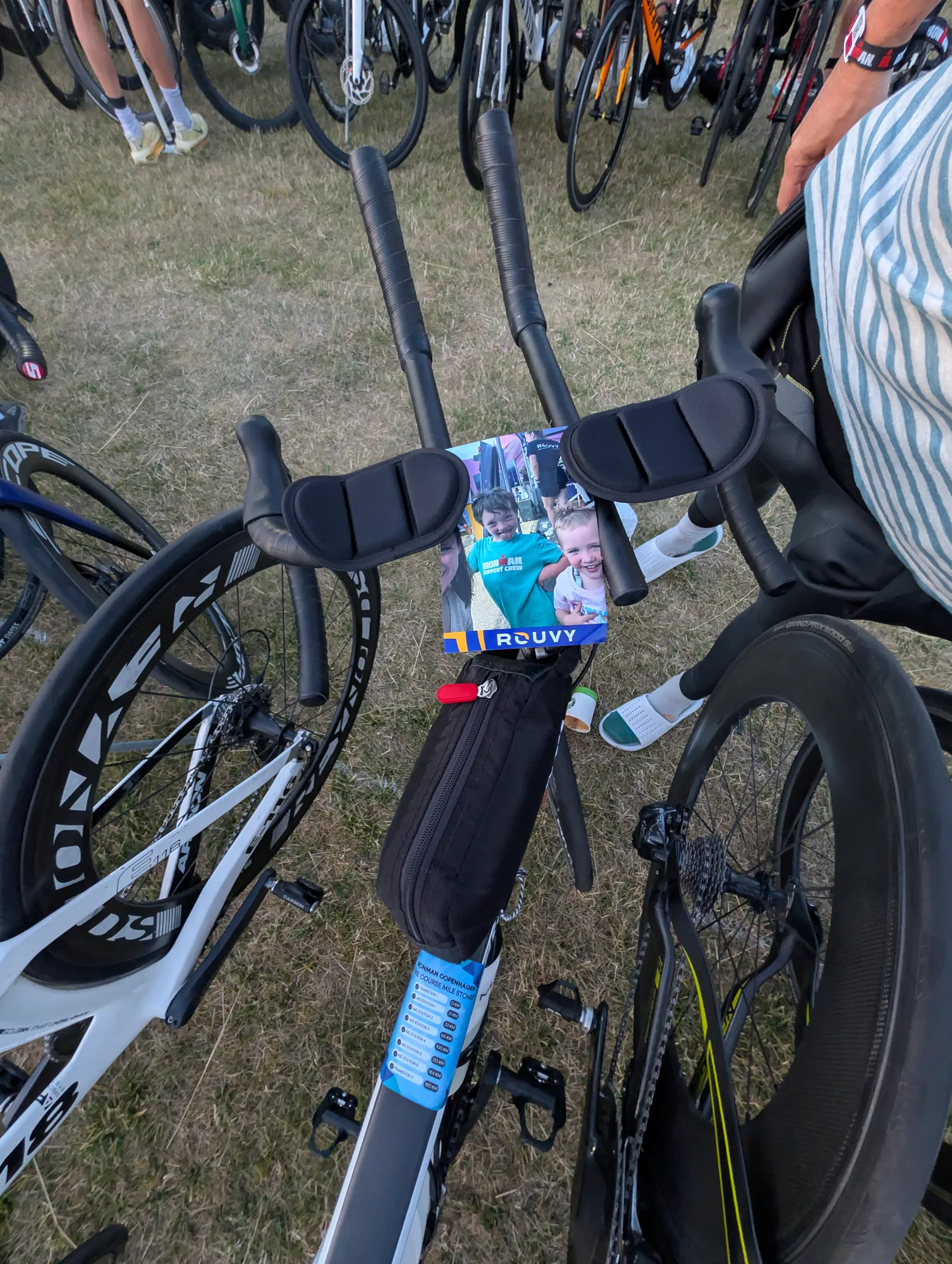
Bike ready with gels in the pouch, a short list of aid stations and a picture of the kiddos. As much as the race is mine, my family is present as my strongest support.
Emma and the kids arrive, and a great friend, Lauren, has come too. The race starts soon, but my wave is roughly 20 minutes later, so we watch it together.
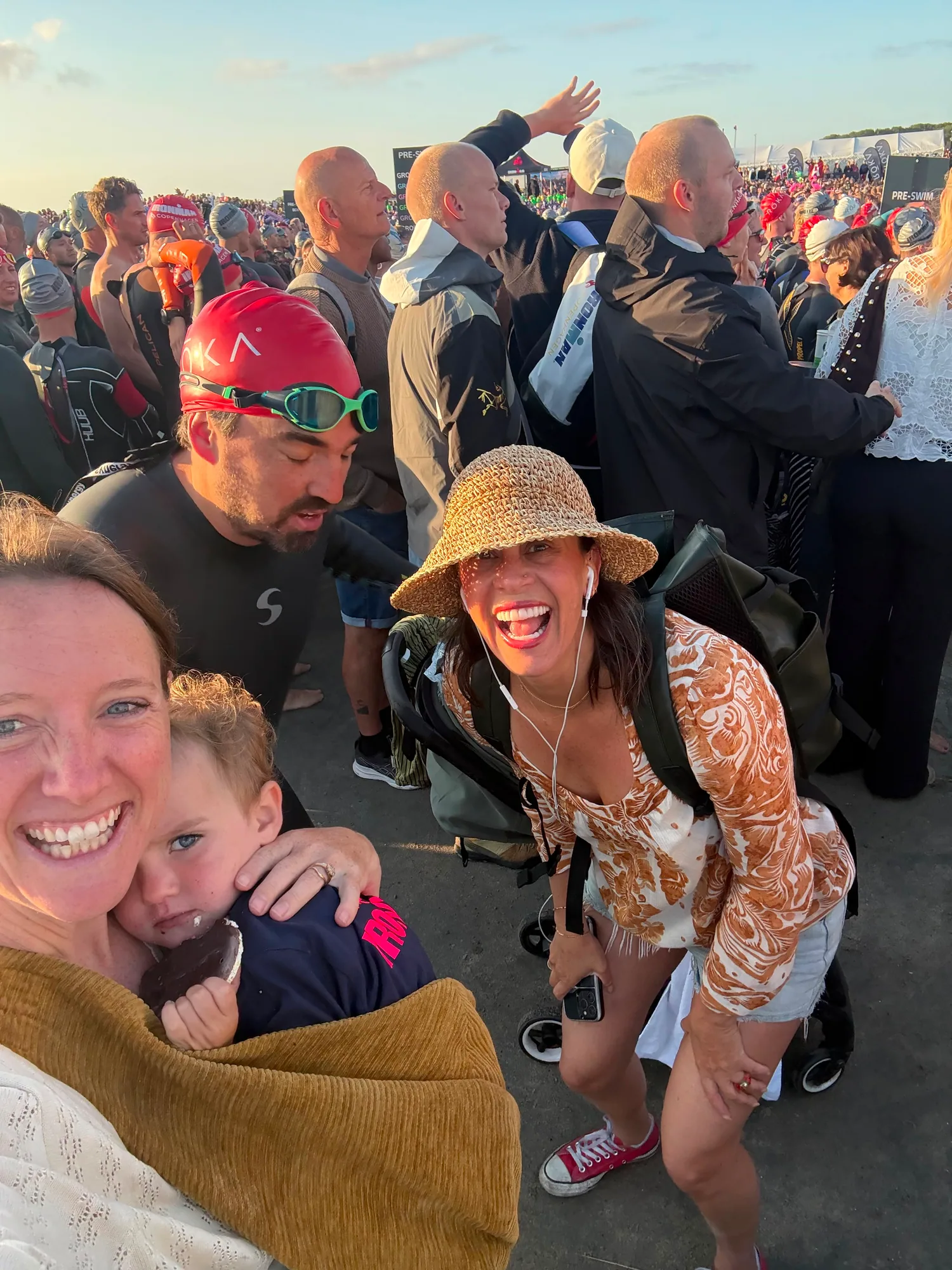
One last moment with the people who would carry me through the day.
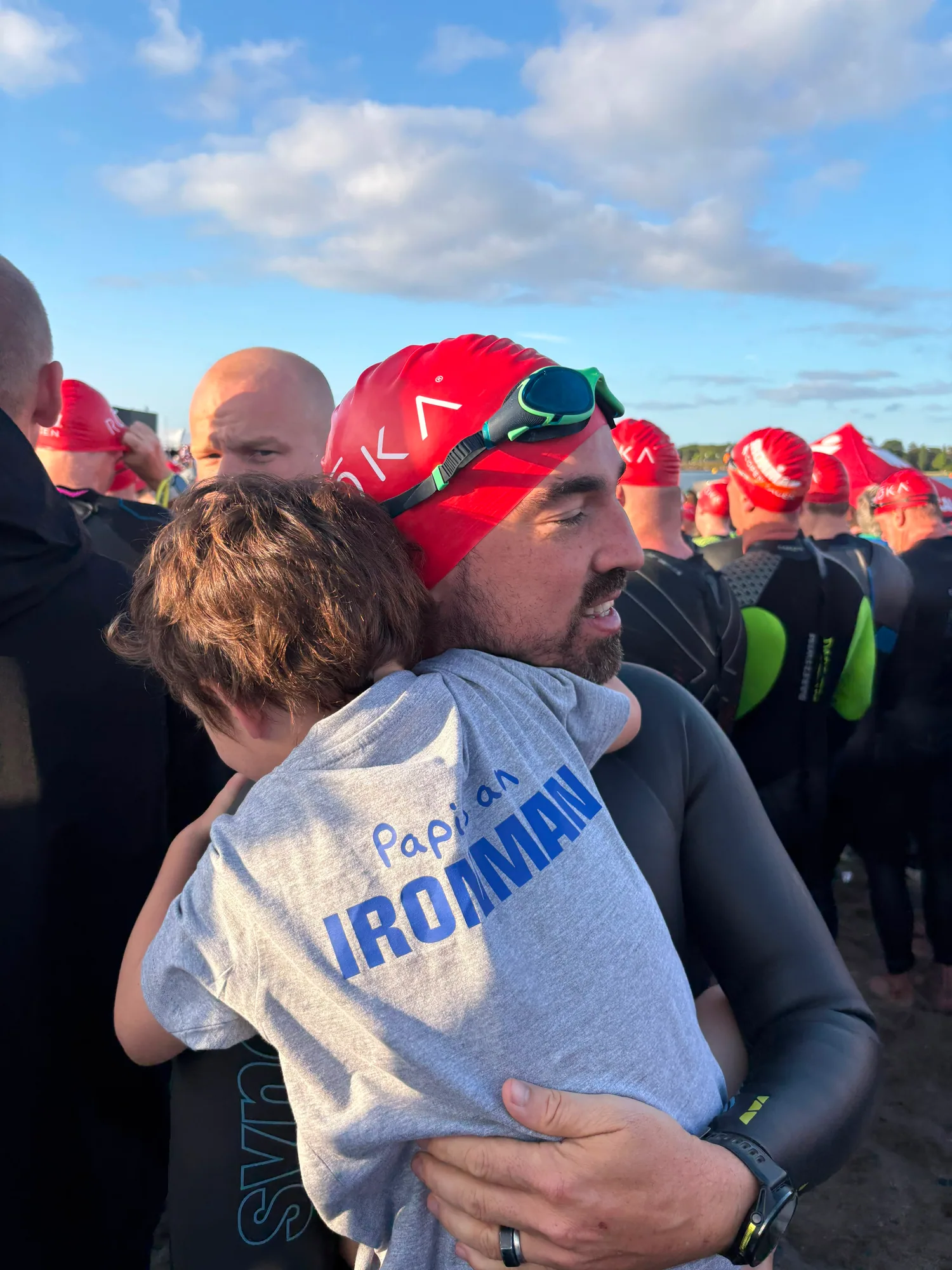
One last hug before the start line.
Then it is time: eat my gel, hugs all round, wetsuit zipped, earplugs, cap, goggles. I turn inward and get ready. Athletes move through the corrals in groups of four, five seconds apart. The person in front of me goes. A volunteer puts out a hand. Five seconds. Garmin on. I look up briefly and think how lucky I am to get to enjoy—and suffer through—this strange day.
“Go.”
Game on.
Swim
The first strokes feel like training, which is exactly the feeling I want. I have only swum the complete 3.8 km once before, in Chattanooga, and my longest recorded swim in this training is 3 km. I am not a particularly good swimmer, but the wetsuit gives useful extra buoyancy.
My greatest swim anxiety is other people. I do not want to be kicked, punched or caught in the middle of a cluster, so I stay outside when I can. This course turns both left and right, which occasionally forces me across the flow. I take a few knocks, but nothing serious.
My pacing rule for an all-day event is to keep my heart rate as low as I reasonably can while still moving smoothly. I relax and find a fluid rhythm. My breathing is controlled, and the distance feels long rather than impossible.
In the last 300 metres I see Emma, Lauren, Sela and Paz jumping and shouting. I smile. The exit is just ahead. I try to enjoy the final strokes because I do not plan to do any swim again for a while.
My official swim time is 1 h 30 min, about 2:22/100 m over the nominal 3.8 km. My Garmin shows a 3% pace fade between recorded-distance halves and an average heart rate of 112 bpm. I am super happy with it.
T1 is simple: wetsuit and goggles off, helmet on immediately, bike shoes, then walk/run to the bike. I see my support crew, stop for a quick hello, mount and go.
Bike
The bike route heads north for roughly an hour and then has two loops. This is where my race derailed ten years ago. Chattanooga was brutally hot, I let my heart rate run too high, and I remember reaching T2 dangerously dizzy. This time the external factor to watch is the wind: strong, with gusts reported at up to 50 km/h. Somehow, on a course with loops, it always seems to be a headwind.
This time I set a personal heart-rate alarm at 130 bpm. My goal for the next seven hours is to stay under that conservative cap, go as fast as the HR cap allows, eat, drink and arrive able to begin a marathon.
My post-race recollection is roughly one gel for every two encounters with a bike aid station, with electrolytes on a similar rhythm. I take a full bottle on the bike. I have a few brief moments of weakness or light-headedness, so I slow down, drink and go on. I had forgotten that on these races you drop your empty bottles at the aid stations, to get new IronMan branded ones. I shouldn’t have bought them the day before :D
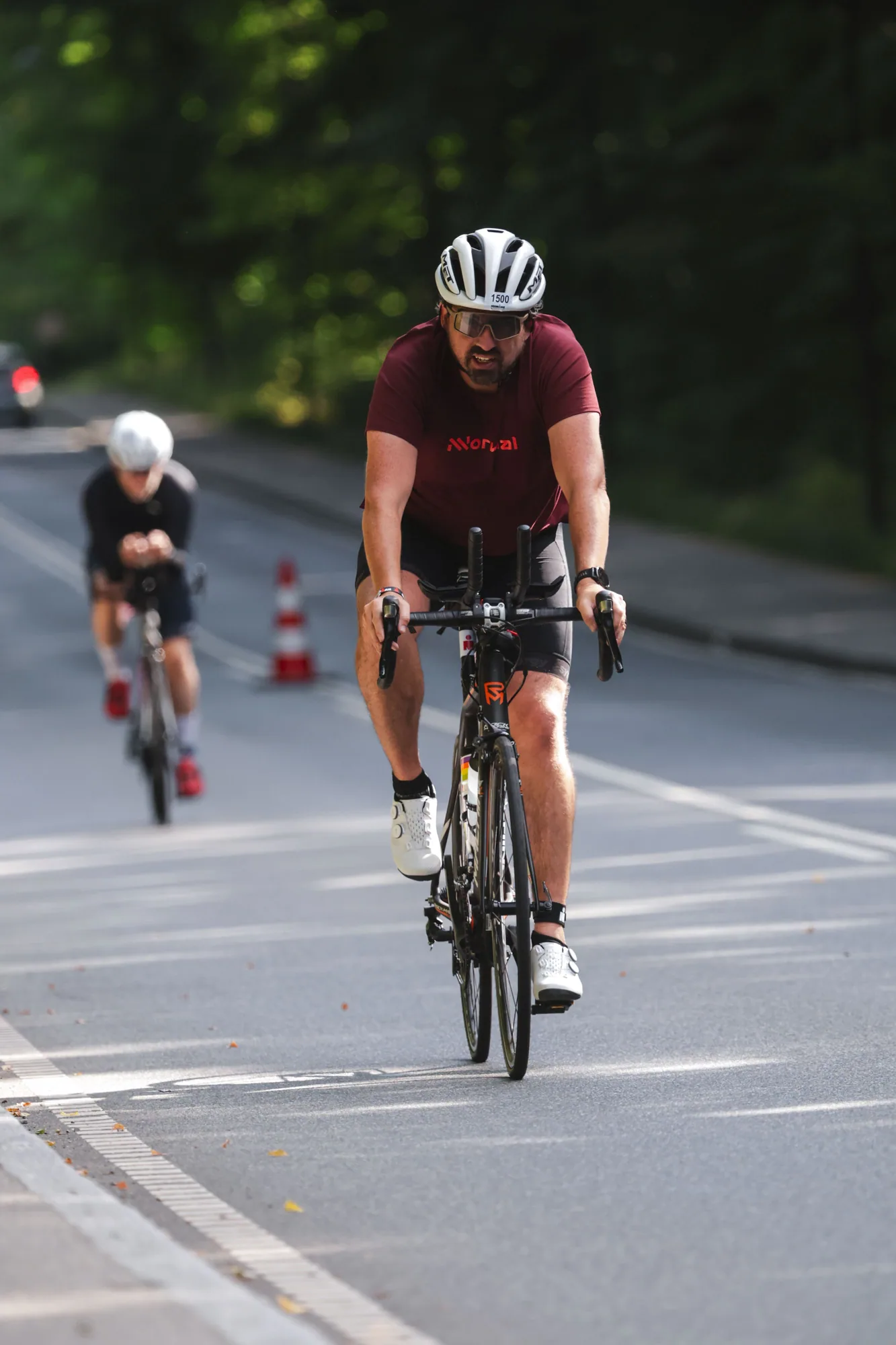
Deliberately unheroic: cap the heart rate, eat, drink and keep moving.
At first my mind is busy with work, life, songs and random ideas. As the nearly seven-hour ride wears on, the mind becomes blank and transactional: gel, gear up, corner, slow down, pedal. A few riders greet me in Spanish after seeing the flag on my bib. That is always fun, especially because on a long course some of the same people reappear. On the first loop, faster riders stream past; on the second, the road becomes eerily quiet, sometimes with nobody visible except one racer far ahead.
Returning to the city towards the end is energising. The route passes streets I rode during our two years living here, and the crowds thicken as the city approaches. I force myself to be present and record the feeling: I have nearly finished the bike, my stomach is calm, and I feel much better than I did ten years ago.
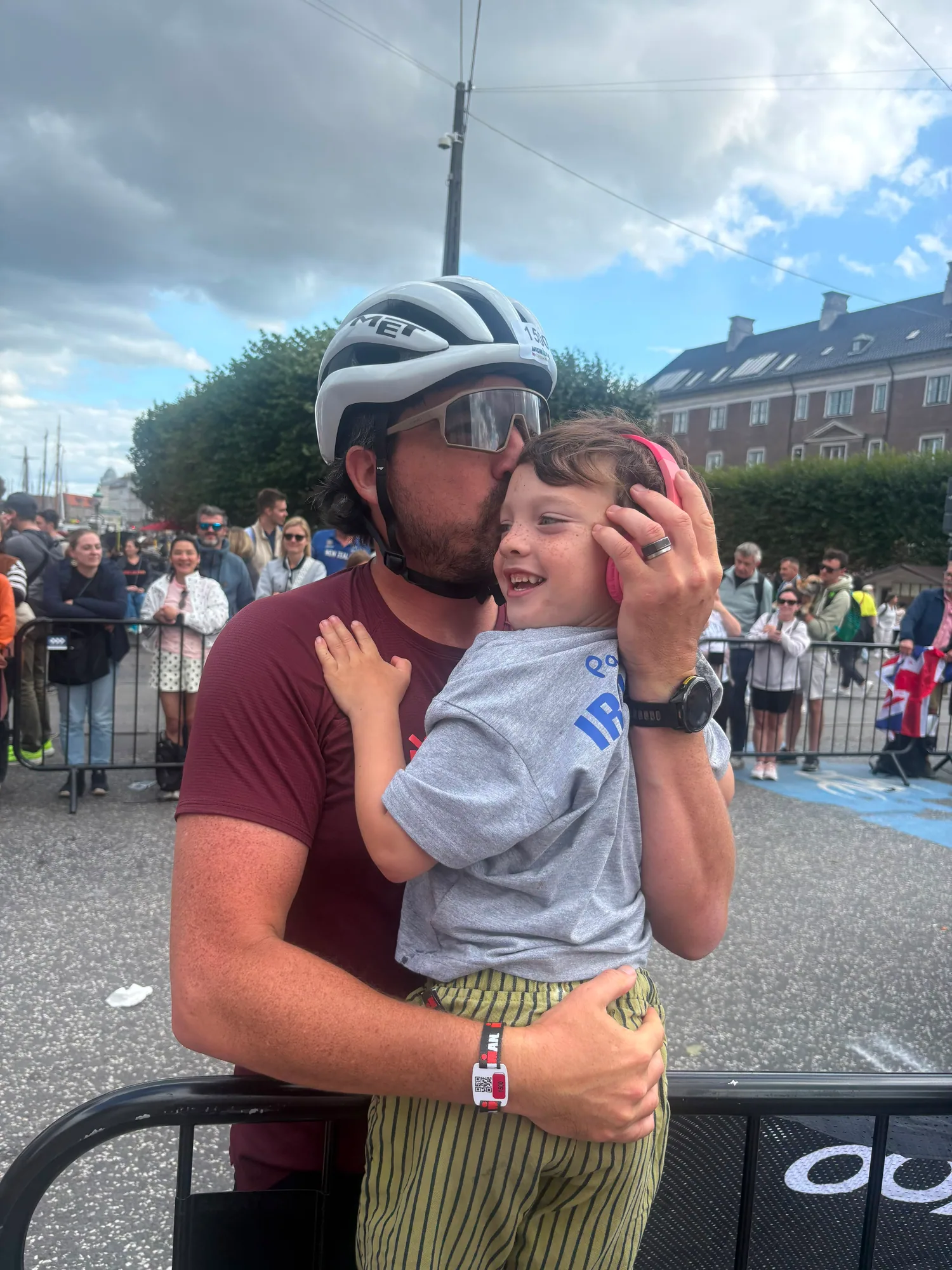
The best aid stop.
I averaged 26 km/h (16 mph) for 6 h 54 min, with an average heart rate of about 121 bpm. It was 44 minutes faster than Chattanooga—not quite a full hour—and I arrived in much better shape physically and mentally.
Run
We reach transition at Kongens Nytorv. I see my crew just beyond the dismount line. Volunteers take the bike, so I can walk over, hug everyone, change shoes and drop the helmet.
Ten years ago I reached this point destroyed and remember sitting in front of a fan for what felt like 20 minutes, drinking water and refusing to believe I still had a marathon ahead. In Copenhagen I am tired but composed. I realize I could walk the marathon and still make the cutoff if I had to, but I have energy to run. Barring injury, with roughly six hours of discomfort still ahead, the finish line feels a bit closer.
The run is four loops through the city. That guarantees people, music and other athletes for almost the entire course, on roads I once walked and ran—alone, with family and with friends. It is a wonderful route. But four loops are also mentally cruel: each runner passing me with a coloured wristband I don’t have announces how many times I still have to run the entire loop.
My plan was to run four minutes and walk one from the start. I do not follow it. This was my biggest mistake this time. I feel good, the cheering and music feel amazing, so I simply run. I remember taking a gel roughly every other station, plus water or electrolyte drink by the cup and pieces of banana. My stomach remains calm and I enter the run with useful energy that slowly fades into struggle then pain.
My subjective loop-by-loop memory is that I run about 80%, then 60%, then 40%, then 20%. My Garmin watch broadly agrees: it estimates that I was running for 55% of the marathon. The deterioration is progressive: every quarter is slower, and heart rate falls along with my speed. That trace describes declining capacity to use phyisical and mental energy. I am taking my gels and drinks, and I have no injury; I am simply suffering more and more. That is when the actual IRONMAN starts. I realise that abandoning the 4:1 run/walk plan was a huge mistake, and now I simply need to adjust and “keep going”. I use small mental rules: run to the aid station; follow this person; try again after the next corner. In these moments, seeing my support crew once each lap becomes the emotional centre of the race. I keep describing an IRONMAN as something I need to experience alone—my body, my mind, my private argument with discomfort … but seeing them is a moment of equal vulnerability and recharge.
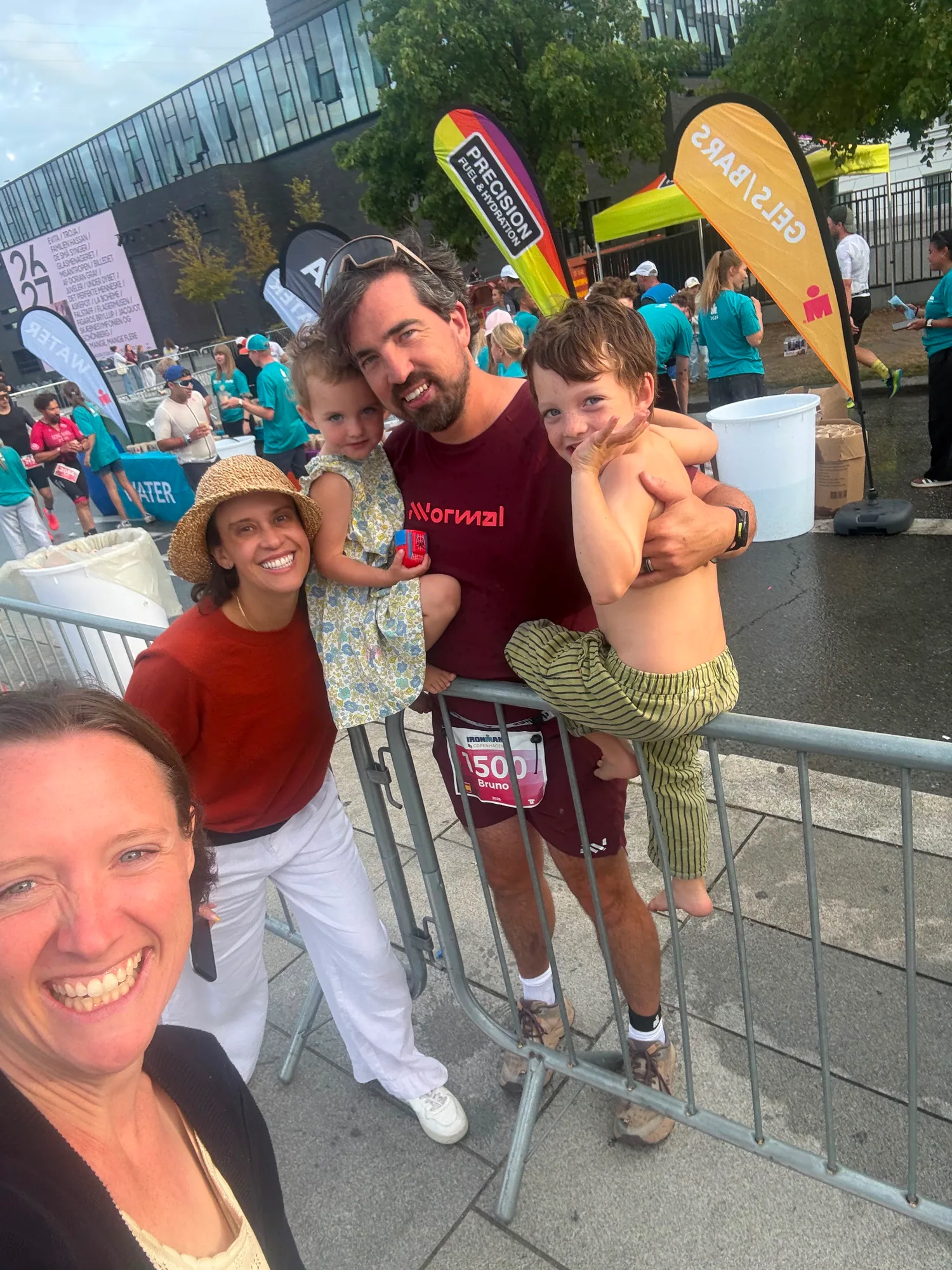
Seeing the crew once each lap became the emotional centre of the race.
The course thins. It gets darker. Some music stations stop. Volunteers begin packing. On the final lap I force myself to be present above the fatigue. I am not planning another IRONMAN soon, so this may be my last final 10 km of one for a decade—or ever. My body aches but responds. I want to run more; it answers clearly: “nope.” Fine. We can walk some more and try again.
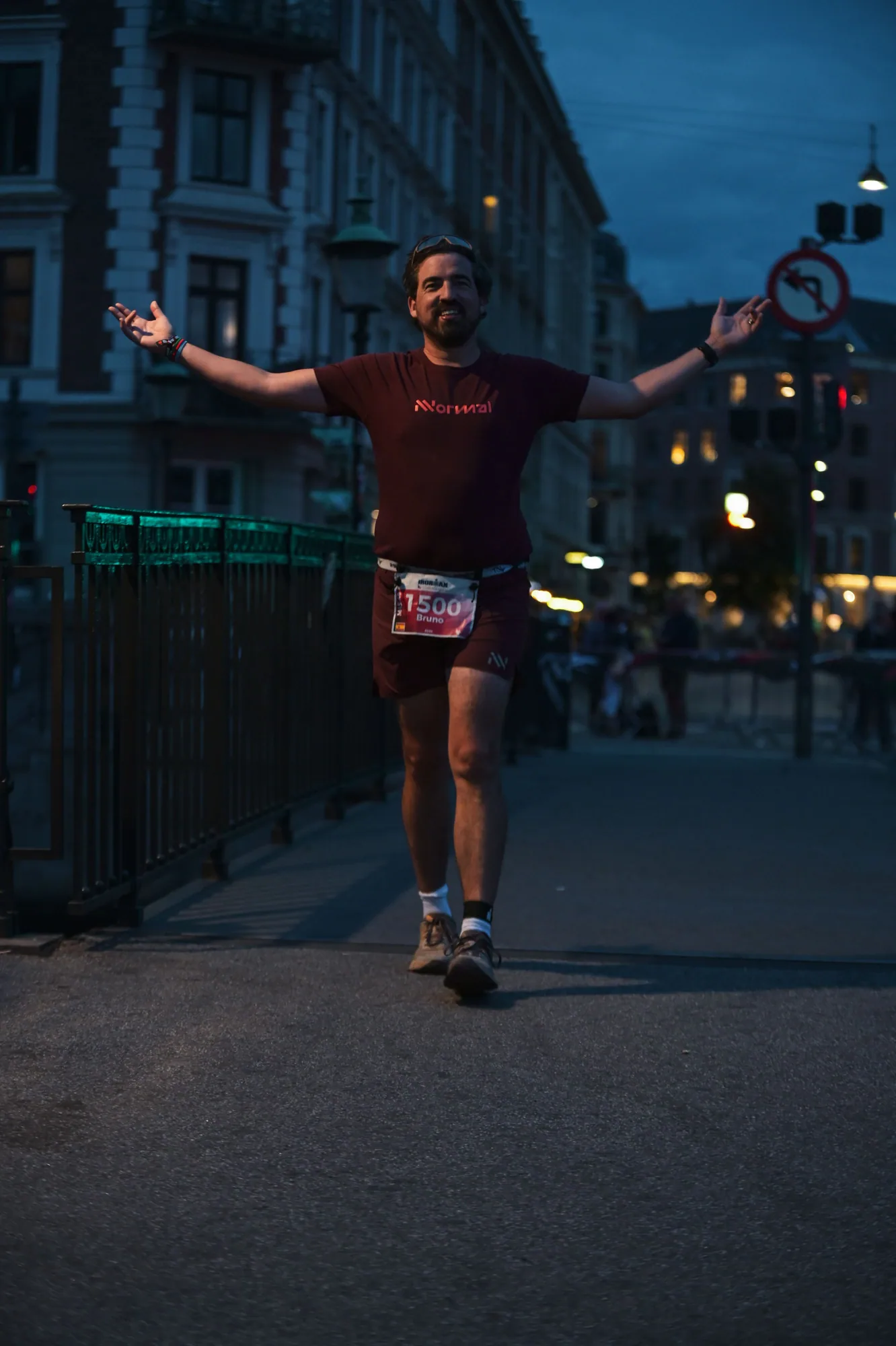
The city thinned, the light disappeared, and I kept moving.
Last kilometre, and the last time I see the crew. I see Emma jumping, Sela asleep in the stroller in the background and Paz in the carrier. Emma deserves a medal too: she has supported this build and spent the whole day carrying two children around the course. I see them and Lauren again just before the finish chute.
The marathon takes just over 6 h. I stop for one last exchange with my crew, then I see that there is nobody immediately ahead of or behind me. I can take my time. Just as I did before starting a whole daylight ago, I look up at the sky. I breathe deeply and run with my arms extended. I do not care how it looks; there are not many moments like this in life.
Lights, music, smoke, red carpet—they really put on a great show—and, with the final drops of energy, a jump across the line.
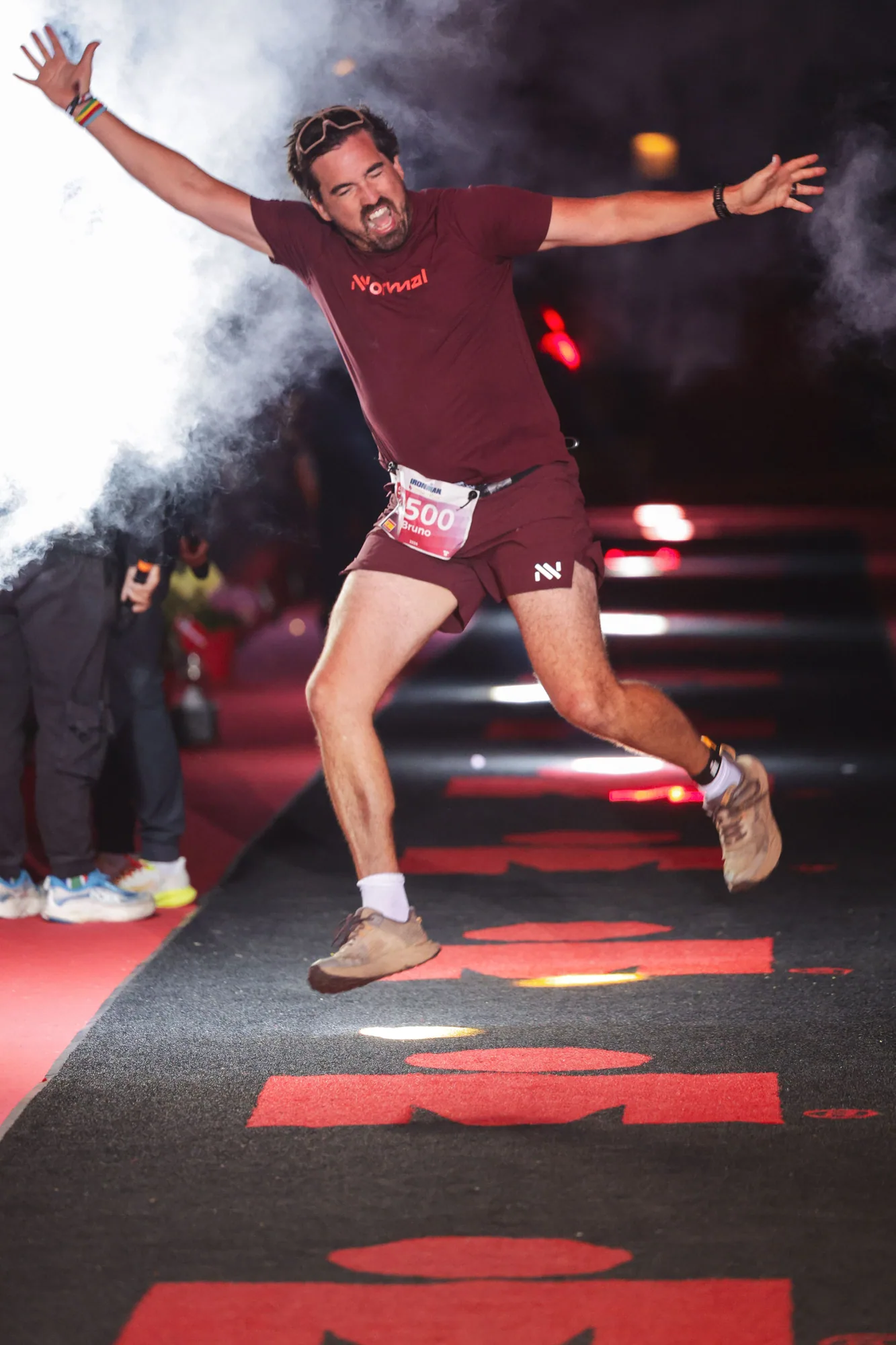
The final drops of energy.
I did it.
What the data logs say
My total time moved from 15:28:30 in Chattanooga to 14:44:56 in Copenhagen. The swim worsened 16 min (Chattanooga was downstream in the river), the bike saved 44 min, T2 saved 11 min and the run saved only 5 min.
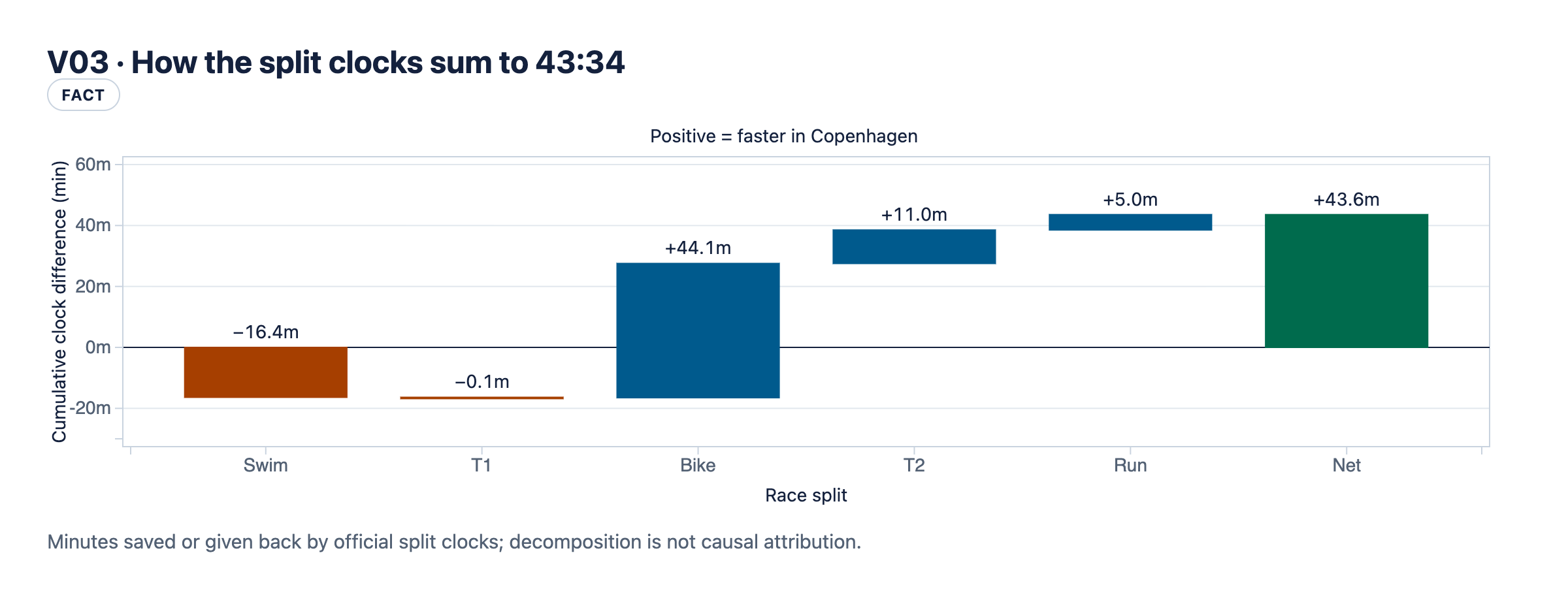
The bike saved 44 min and T2 saved 11 min; the swim gave back 16 min, T1 eight seconds, and the run saved 5 min. Split arithmetic locates clock changes but does not identify their causes.
Chattanooga’s reported 36°C heat and the very different courses make direct clock comparisons difficult. The public result-status ledgers also show very different attrition: DNF records were 561/2,214 non-DNS records (25%) in Chattanooga and 76/2,591 (3%) in Copenhagen.
In terms of how far I was from being last, my swim left 24% of same-age finishers behind me in Chattanooga and 24% in Copenhagen. T1 moved from 45% to 41%, and the bike from 8% to 7%. T2 improved from 4% to 20%, while the run fell from 30% to 5%. Overall, I left 13% of displayed same-age finishers behind in Chattanooga and 6% in Copenhagen. These positions describe two different event fields, not the same people aging together.
The training factor
The matched-window training comparison says I kept showing up but the average session got shorter.
| Recorded build | Chattanooga (230 d) | Copenhagen (189 d) |
|---|---|---|
| Swim time | 34 h | 12 h |
| Bike time | 110 h | 77 h |
| Run time | 74 h | 58 h |
| Swim distance | 84 km | 27 km |
| Bike distance | 2,559 km | 1,283 km |
| Run distance | 704 km | 490 km |
Specificity contracted even more. My longest recorded bike ride fell from 174 to 74 km. Rides of at least one hour followed by runs of at least ten minutes—my fixed definition of a meaningful brick for this comparison—fell from 21 to 2 workouts.
Nutrition went better
Subjectively, nutrition and hydration went much better than in Chattanooga. My stomach stayed calm, I reached the run able to eat, and I never experienced the catastrophic dizziness I remember from 2016. That matters.
I am a slow IRONMAN finisher
In this Copenhagen race:
- Overall: 2,426th of 2,501 ranked finishers, with 3% behind me.
- Men: 1,983rd of 2,030, with 2% behind me.
- M45–49: 157th of 167, with 6% behind me.
Across 15,858 coherent Copenhagen finish records from 2013–2019, 404—or 3%—were strictly slower than my time. A worldwide open study and dataset of official IRONMAN records reports 677,702 records after preprocessing. For my local clock comparison, I retained 676,772 records after applying stricter coherence filters; 105,942 were strictly slower and 16 tied my rounded second, so 105,958—or 16%—were as slow as or slower than my time.
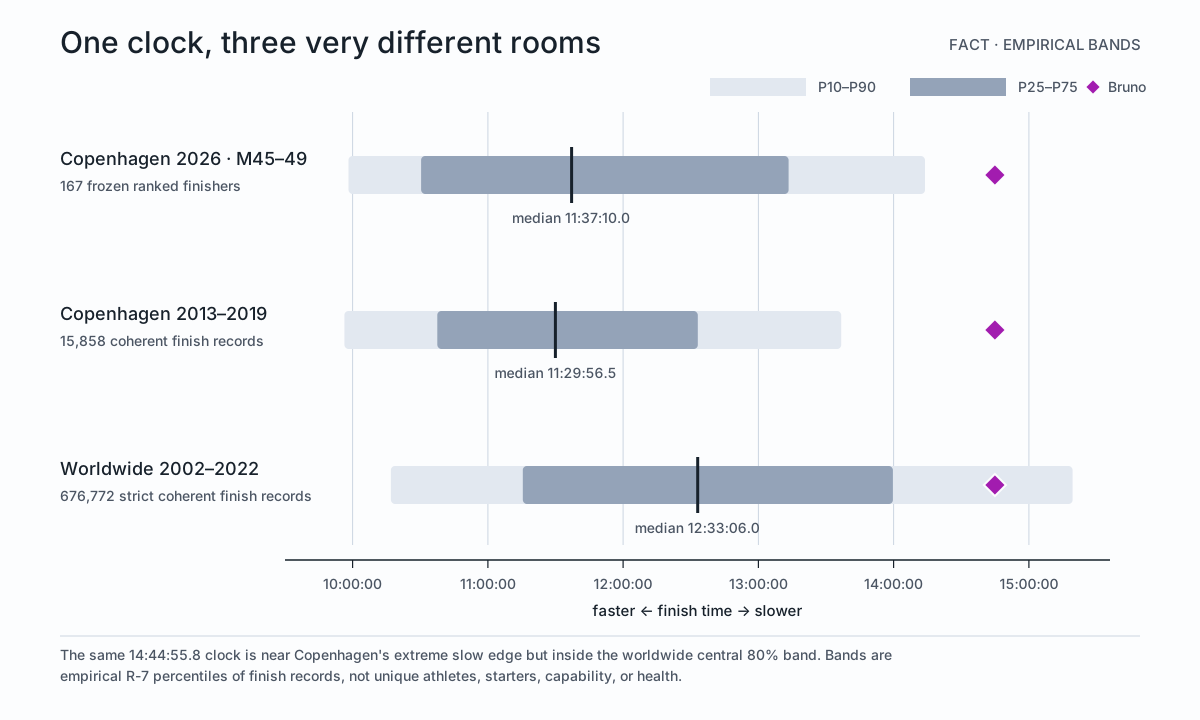
The same 14:44:56 clock is near Copenhagen’s extreme slow edge but inside the worldwide central 80% band. Bands are empirical R-7 percentiles of finish records, not unique athletes, starters, capability or health.
The IRONMAN cohort is highly selected, and it is hard to quantify. To help estimate it, in Spain’s 2024/25 sport survey, 69% of people aged 45–54 reported doing some sport in the previous year, and 59% reported doing sport weekly. Among sport-active respondents aged 25–54, 1% reported participating in a triathlon in the previous year—any distance, not necessarily an IRONMAN. The survey cannot tell me what share of the general population completed a full-distance race, so I should not turn those figures into a probability or population percentile for myself. The defensible conclusion is narrower: I was near the back of a selected field doing a rare kind of event.
The striking gender imbalance
Only 471 of Copenhagen’s 2,501 ranked finishers were women: 19%.
The raw strict status-derived ranked-finisher rates were similar by sex. Among non-DNS status records, 471/491 women (96%) and 2,030/2,099 men (96%) were ranked finishers; DNF shares were 3% and 3%, respectively. These are status-ledger denominators, not physical start-mat counts.
In Table 2 of that 687,696-record worldwide study, women had slower raw mean finish times in every age group. In the four bands I use elsewhere here, women versus men averaged:
- 13h07m vs 12h19m at 25–29,
- 13h19m vs 12h20m at 35–39,
- 13h43m vs 12h44m at 45–49,
- 14h18m vs 13h27m at 55–59.
Notice how the delta decreases with age.
What the finish says about health
Part of why I do this is health. As I get older, I wanted a demanding project that makes aerobic capacity, body awareness, recovery and preventive care difficult to ignore. Finishing an IRONMAN demonstrates demanding integrated function during buildup and on race day.
Across 52,706 valid heart-rate samples inside the repaired wearable race window, my P10/P50/P90 heart-rate estimates were 102/118/128 bpm. Sustaining that is in itself a pre-requisite of a certain level of mental and physical endurance. The watch and Oura estimate around 7,000 to 9,000 kcal of energy expenditure. That is roughly the equivalent of 4 days of a normal diet, 32 slices of pizza, 16 Big Macs, or 65 regular cans of Coca-Cola.
One recovery constraint that stunted my training consistently was lack of sleep. With small children, travel, jet lag, work and stress, my wearable reported an average of 6 h per night over the 90 days before the race, even while I was trying to sleep more to support recovery. My average over the preceding 365 days is 6.21 h per night.
What went well and what went badly
Went well
- I finished a second full IRONMAN at 45, ten years after the first.
- I was 43 min faster overall.
- Swim pacing was controlled, and its same-age position was almost identical.
- The bike delivered the largest clock improvement despite a windy day.
- I began the run composed rather than destroyed.
- My stomach stayed calm, I avoided injury, and I repeatedly managed to be present and enjoy the day.
- I had crew support in family and friends.
Went badly
- The training build did not contain enough long, post-bike-specific work for the run I wanted.
- I abandoned the planned 4:1 run/walk discipline from the start.
- Pace, HR and running share deteriorated throughout the marathon.
- Recorded sleep remained short relative to my recovery goal.
What I want the 55-year-old to inherit
At 45 I was faster than the 35-year-old on the clock and slower relative to my peers. I managed the swim, bike, transitions and stomach better despite a lower-volume build, then made a clear pacing mistake and exposed the training specificity I had not protected.
Copenhagen’s male age-group medians show an interesting selected-field pattern. In this one race, medians were 10:41:16 for M25–29, 11:02:47 for M35–39, 11:37:10 for M45–49 and 11:51:26 for M55–59. Displayed cohort counts fell from 494 to 224 to 167 to 97.
Those smaller older fields do not tell me whether I will return, and the cross-sectional medians do not predict my time at 55. They describe different selected groups of finishers in one race, not what happens to one person over a decade.
I do not know whether the 55-year-old me will want another IRONMAN. Success does not mean obliging him to do one or predicting his time from today’s cohort. Success will be to keep my body and mind healthy enough, motivated enough for life and supported enough that I can choose whether to do it.
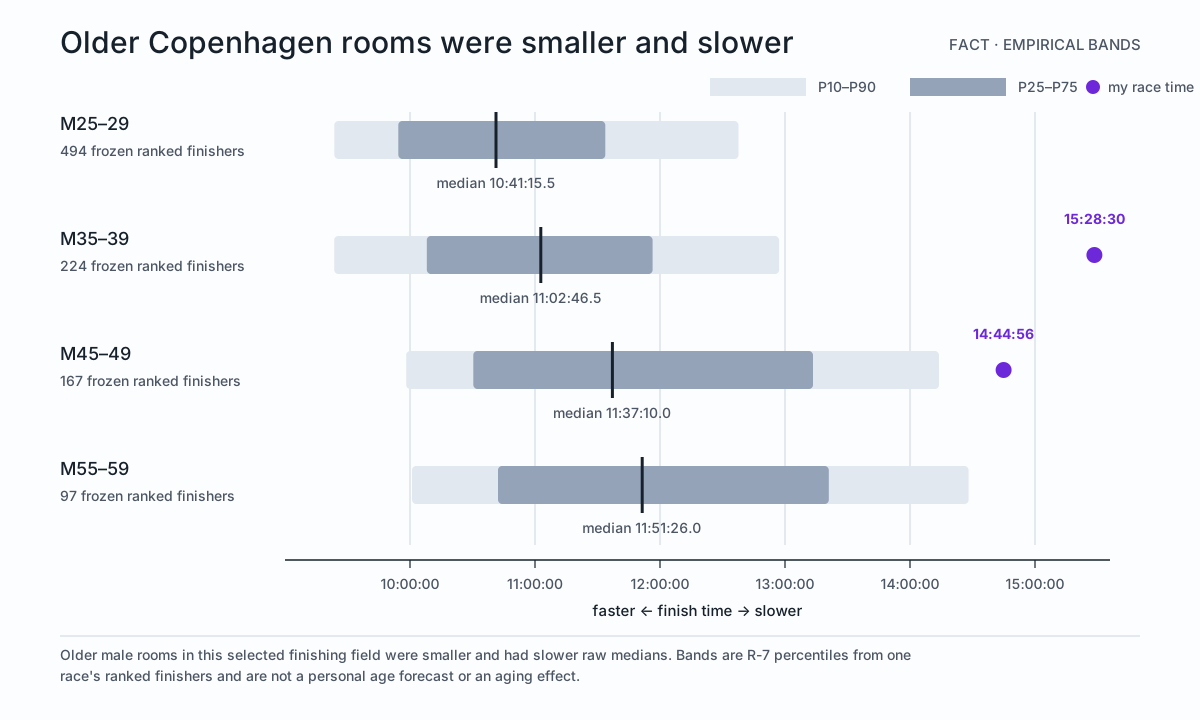
Older male cohorts in this selected finishing field were smaller and had slower raw medians.