AI asks the world for more power, water and land while overlooking the very data that measures those same resources. The AI environmental pushback has moved from activism to law, in great part through data centre opposition, the physical anchor of AI. Ireland now requires new data centres connecting to the grid to provide matching generation or storage capacity, onsite or nearby. In the US, Amazon withdrew its application for a 1,370-acre Virginia campus after local opposition. AI is increasingly a divisive political line.
Climate Week’s AI debate can feel stuck between accounting for its footprint and promising future efficiency. Al Gore said in a recent interview that AI’s emissions are “a cause for concern but not panic”, and that AI could cut billions of tonnes a year by making energy systems efficient. Yet, a recent model-based study projected that AI-driven gains in fossil fuel productivity could outweigh avoided emissions from renewables. Progress is real, yet we remain ambivalent about the very Earth we both impact and promise to protect. And all along we have indeed observed Earth constantly and globally from space.
I want the ChatGPTs and Claudes we use to ground their answers on Earth data, not just Internet descriptions of it. I’ve been working on tech and Earth observation for decades, including at a non-profit and a for-profit I cofounded, and time at the World Bank helping land techno-optimism in the messy reality where promises are often needed most. AI follows the same pattern, it seems to struggle to land on our most real Earth. You can test it: Ask any leading AI about drought and you get a very good essay. Ask which reservoir is low this week, or whether the field behind a proposed data centre floods in March. These models have read vast amounts of what humans wrote about countless worlds, real or fictional, while the direct measurements of the one we live in remain hard to use.
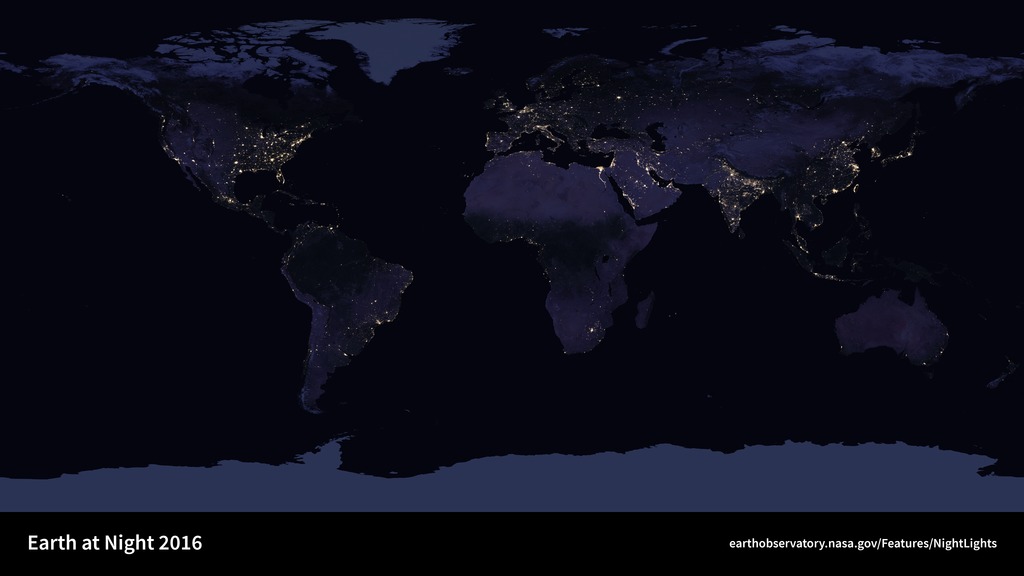
At the World Bank we once did a small version of this: Nightlights used DMSP satellite data to detect light in every village in India, measuring electrification from orbit rather than from paper reports. The measurements were already there, waiting for a system that could scale precise measurement to every single Indian village, every single night. We did it, and it wasn’t easy. With AI, I am pretty sure it would have taken an order of magnitude less time and resources.
In 2019 the computer scientist Richard Sutton wrote a short essay, “The Bitter Lesson”: for 70 years, general methods that soak up relevant data and more computation have beaten clever methods crafted from expert knowledge. It happened in chess, then speech, then vision. Every time the experts were sure the craft of their field was different, and every time scaling data and computing won. So we keep scaling. The planet has two bitter lessons still pending, one for each side.
The first is for Earth observation scientists, me included. We spent a decade building bespoke models: one for crops, one for buildings, one for floods. A recent audit by Isaac Corley and colleagues found 152 papers evaluated on 401 different benchmarks, with contradictory results. Meanwhile the AI models we use keep eating into the geospatial turf. Google’s experimental Planetary Prediction Engine uses a language model to orchestrate geospatial data discovery and model building. Of course, niche models for niche questions will survive, but most geo models will be retired once general models do the job faster. That is the bitter part for us.
The second is for those AI labs that keep scaling. AI was born from reading an entire internet. You can read the 18 documents the biggest labs published with their new models. None mentions Earth observation as an input. Same with the newer so-called “world models” built to simulate the physical world. No Earth data was mentioned, despite petabytes of open data constantly sensing the whole world. Not mentioning it doesn’t mean they don’t use it, but if so it reflects grounding models on Earth is not a priority. Either way, we seem to choose not to see. In late September, ESA and Mistral signed a Letter of Intent to explore AI applications including Earth observation. That is a breath of fresh air from a general-purpose AI company, although the agreement is a framework for further work, not evidence that its models already use live Earth observations.
AI for Earth is moving beyond academia and philanthropy, but access remains uneven. Microsoft’s $50m “AI for Earth” (a programme I directed, and am proud of: the Planetary Computer was born there) focused on Azure credit grants and research. Google and Amazon did similar. The World Economic Forum’s 2026 Earth observation report estimates that $263bn in annual value remains unrealized across data acquisition, processing and deployment. The missing connection to widely used AI assistants is part of that challenge. The World Bank’s World Development Report 2026: The Promise of Artificial Intelligence, the first comprehensive assessment of AI for developing economies, lands nearby: it calls on countries to “improve the availability of local data” so AI tools can be adapted to local conditions, noting they “do not need large models or big data centers to reap its benefits.” Continuously sensed Earth data is local data at planetary scale: already collected, largely open, and exactly the input that argument assumes. Earth sensing is AI’s unfinished homework, and the cost is arriving as pushback over an environmental footprint that AI itself could help measure.
The AI industry has many problems, and the political ones feel more urgent, but nature tends to double down when ignored. The upside is also plain. If an internet written by humans got us this far, a whole Earth of data should anchor it in reality. My bet is that reliable access to live Earth observations could become as ordinary as searching the web, making AI more useful for decisions about water, land and infrastructure. I’m also convinced it will improve AI’s grasp of the physical world. Either way, this won’t erase AI’s environmental costs; but it would give us a more Earth grounded conversation.
Also published on LinkedIn.