Impact Science for people and planet

Bruno Sánchez-Andrade Nuño, PhD builds AI at planetary scale: co-founder & Chief Scientist of LGND, co-founder of Clay, and founder of the Microsoft Planetary Computer. Two decades turning frontier science into products, teams, and capital — at Microsoft, the World Bank, and Mapbox.

He is the author of Impact Science — a guide for getting from research to radical breakthroughs. He serves select boards and advises climate and deep tech funds on earth observation and geo-AI. Recognized as a Young Global Leader by the World Economic Forum. Originally from Asturias, Spain; based in Copenhagen.

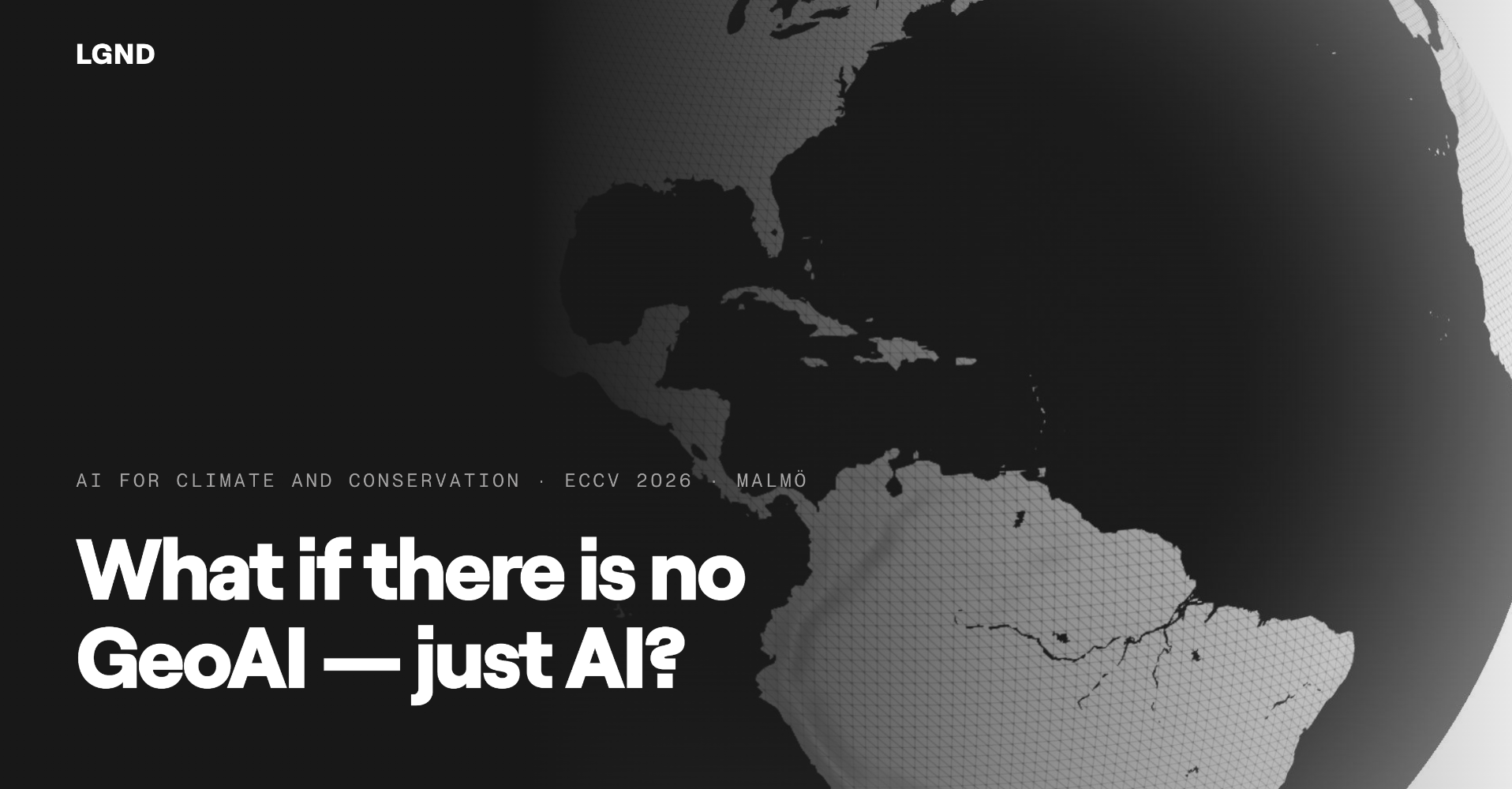
Title slide: What if there is no GeoAI — just AI? AI for Climate and Conservation, ECCV 2026, Malmö.

What if there is no GeoAI — just AI?

Also published on LinkedIn. Those of us at the intersection of EO and AI still have a lot to bring, but further maturing a separate domain might not be the most impact-driven path. This is the article form of the talk I gave at #ECCV conference workship on Conservation and Climate change. Thank you Climate AI Nordics for the invitation. Hope I was able to sir the pot enough. Is geodata just data? We geo experts adopt most frontier techniques fast — SAM (“Segment Anything Model”) was applied to satellite imagery within three weeks, with fantastic applicability. Yet there is no evidence that the general-purpose frontier models (Gemini, GPT, Claude, DeepSeek, Kimi, GLM) treat Earth observation in any of the specific ways we in GeoAI do: feature engineering around metadata, rasters, projections, bands, and sensor physics. Models that do accept images expose only an RGB image interface, and while they can appear well versed and able to generate GIS code, the primitives that define GeoAI (e.g. geoattention) are absent from their published core architectures. I have reviewed eighteen frontier-lab model cards and technical reports from this year. Not one documents an Earth-observation input or an Earth-observation benchmark. This is absence of evidence, not evidence of absence, but it does show that geo is not a publicly stated architectural priority. ...
September 9, 2026 · 16 min · Bruno Sánchez-Andrade Nuño

A faster race, a slower IRONMAN: Copenhagen 2026, ten years later

I finished my second IRONMAN at 45 years of age in 14 h 44 min 56 s—43 minutes and 34 seconds faster than when I did it at 35. I was also 157th of 167 men in the M45–49 division. It was hard—really hard—but I honestly enjoyed it. To be precise, I enjoyed discovering that I still had the physical endurance and mental will to complete such a challenge. The human body and mind are amazing. It is also true that I may be the slowest IRONMAN finisher you will ever meet: of 2,501 ranked finishers, only 75 finished behind me. This race had a particularly fast cohort, and I was near the back of it. That is totally fine with me. It is a rare cohort to belong to, below I calculate exactly how rare. ...

August 23, 2026 · 18 min · Bruno Sánchez-Andrade Nuño

The European Space Market Needs to De-risk Demand, Not Just Supply

The European space ecosystem funds top research, makes and opens extremely valuable data, trains top scientists and engineers … then buys the finished capability from abroad, often with European roots. What can break this pattern is to copy what works elsewhere: crowd in public customers to de-risk dependable home-market demand (not supply). Growth investment will follow, and so will the benefits. Ljubljana — Sinergise’s hometown — as seen by Copernicus Sentinel-2: the open data a small Slovenian team turned into a product the world used. Contains modified Copernicus Sentinel data (2020), processed by ESA (CC BY-SA 3.0 IGO). ...

July 1, 2026 · 6 min · Bruno Sánchez-Andrade Nuño

Data Centers in Space: The Wrong Chip in the Right Place

Update,5 hours after I posted this. NVIDIA announced Space-1 Vera Rubin Module at GTC, alongside Jetson Orin and Jetson Thor for orbital deployment. Planet will fly Jetson Thor on its next-gen satellites. Jensen Huang said: “In space, there’s no convection, there’s just radiation — and so we have to figure out how to cool these systems.” He confirms the thesis I write below. The chips actually shipping to orbit — Jetson Orin (42 TFLOPS, 60W) and Jetson Thor (~517 FP16 TFLOPS, 130W) — land exactly on the inference sweet spot identified below. Space-1 Vera Rubin promises 25× the H100 but has no published TDP and no ship date. The datacenter version runs at 1,800–2,300W. Sophia Space describes its platforms as “passively cooled.” The chips that fly are inference-class, not training-class. NVIDIA just formalized the split that T⁴ demanded. I’ve updated the image with the new chips. ...

March 15, 2026 · 13 min · Bruno Sánchez-Andrade Nuño

What an AI Sees When It Reads Your Life

Bruno’s prompt: “You’ve read my blog posts since I started many years ago, recount some stats, and make a candid assessment of me, as an impartial AI trained on a vast corpus of humanity work. What do you see in Bruno? I’m curious. Post this as a blog post with this explanation. I won’t edit it.” Context: I spent today rebuilding this site. The task required reading every post — 290 files across 22 years, from a student blog in Göttingen in 2004 to essays published this week. ...

February 26, 2026 · 3 min · Bruno Sánchez-Andrade Nuño

The Abundant Intelligence Economy

You might have read how AI is the end of society. Perhaps Alap Shah’s “2028 global intelligence crisis” fearing a 38% S&P crash and a white-collar displacement spiral. Or Matt Shumer and the end of coding. Or Leopold Aschenbrenner “Situational Awareness” trillion-dollar compute clusters. TechCrunch: “the gradual unspooling of the economy itself.” But notice every single one of them is on the capital side of the table. They see what happens to the world (which they fund). But what about the rest of us? — the builders, the consumers, the nature lovers, the patients, … IMO news of society’s death is greatly exaggerated. ...

February 24, 2026 · 3 min · Bruno Sánchez-Andrade Nuño

AI Is Paid by the Word

AI is paid by the word. That’s not a metaphor — tokens are literally what you pay for. That’s why AI loves to be verbose, to generate more “tokens”… it’s a feature, not a bug. This is literally how they reason, and this is how most AI is monetized, what you pay. “Vibe coding”, “Thinking”, “planning”, “agents” … layers upon layers of less and less visible internal narrative you paid. This is only getting worse as the “price per token” (what the “pricing page” shows) gets cheaper and we follow the Jevons paradox. There isn’t much attention to tokens used per outcome. ...

February 22, 2026 · 2 min · Bruno Sánchez-Andrade Nuño

Visions of Earth Intelligence

This is the article version of the invited talk I gave at the BSC AI Factory of Barcelona, during a CARTO event. The title ‘Earth Intelligence’ sounds like science fiction or philosophy. It isn’t. This is not a wish list for future data or tech I wish we had. We do in fact have enough data and tools. This is about the simplest, fastest way to access planetary insights right now. What a time to be working on this! ...

February 5, 2026 · 10 min · Bruno Sánchez-Andrade Nuño

Davos 2026: Planetary Awareness in a Fractured World

This meeting remains the densest gathering of decision-makers anywhere: public, private, science, technology, and civil society, all compressed into one intense week. There’s nothing like Davos, and overall we do need Davos, imo. I was on the ground, but our whole team worked incredibly hard to make this week count. Between interviews, articles, meetings, panels, and strategy sessions, the pace was unrelenting. And yet, looking back at the blur of 72 calendar entries and the “who’s who”, it is hard for me not to feel the familiar tug of “more”. One more session. One more corridor conversation. One more unexpected connection. ...

January 25, 2026 · 3 min · Bruno Sánchez-Andrade Nuño

Going to Davos as a Parent

I’ll miss bedtime stories next week. Not because I love the 75 events in my calendar at Davos, but because I’m carrying something personal with me. My kids are growing up in the EU, in Denmark, where safety, nature, and independence are built into everyday life. That kind of childhood isn’t magic. It’s the result of decades of public investment, data, and care. For most of the world, that model has simply been out of reach. At LGND AI and Clay we’re building extremely horizontal planetary intelligence: tools designed to understand the world at scale. Child infrastructure, air quality, climate risk, food security, disaster response. This is just one possible use. ...

January 17, 2026 · 1 min · Bruno Sánchez-Andrade Nuño